

Application number: 10-2015-0163727 (출원일: 2015-11-23)
Registration number: 10-1753561 (등록일: 2017-06-28)
Patentee: Chungnam National University Industry-Academic Cooperation Foundation
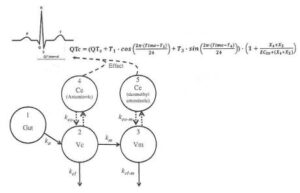
Abstract: The present invention relates to a pharmacokinetic/pharmacodynamic model for evaluating drug-induced QT prolongation syndrome in the drug development process, and improves the sensitivity for detecting drug-induced QT prolongation syndrome by resolving the failure to distinguish between circadian rhythm and drug-induced changes in the QTc interval, which was regarded as a limitation of existing pharmacokinetic/pharmacodynamic models for predicting QT prolongation syndrome. Therefore, through the pharmacokinetic/pharmacodynamic model for predicting QT prolongation syndrome of the present invention, the risk of drug-induced arrhythmia can be predicted more accurately in new drug development, and it is expected that drug safety can be enhanced.
Representative claim: 약물의 약동/약력학적 모델을 이용하는 QT 연장증후군 예측 방법으로서, 약물 투여 전 및 후의 환자의 맥박수 및 심전도를 측정하는 단계;약물이 투여된 환자의 시간에 따른 혈중 약물 농도를 측정하는 단계;측정된 심전도 및 투여된 상기 약물의 투여 정보를 입력하는 단계;상기 혈중 약물 농도의 측정치를 통하여 모델링을 수행하는 단계; 및입력된 심전도, 혈중 약물 농도 및 약물의 투여 정보를 하기의 구축한 약동/약력학적 모델에 적용하여 QTc 간격 변화를 결정하는 단계;를 포함하는 것을 특징으로 하는 QT 연장증후군 예측 방법. 상기 약물의 약동/약력학적 모델은, [이미지]여기서 T1과 T3는 활동일주기에 의해 유발된 QTc 증폭을 의미하며, (time-T2)/24와 (time-T4)/24는 활동일주기 기간을 나타내고, QT0는 기본 QTc 수치로서 정상 상태에서의 QTc 수치를 의미하며, Xj(j=4, 5)은 각 생체 상 구획의 약물 농도를, EC50는 약물의 효과가 절반이 될 때 약물의 농도를 의미한다.
Details link: http://newsd.wips.co.kr/wipslink/api/dkrdshtm.wips?skey=3517272000860